From Igbo-Ukwu bronzes to FESTAC ’77, African and Diaspora art is shaping what designers make. But borrowing from art and working with art are not the same thing.
NOVEMBER 2026 • LAGOS • COPENHAGEN • LONDON • NEW YORK
Guards from Bornu at the Grand Durbar in Kaduna, one of the events of FESTAC ’77. At the festival, dress itself was a form of art.
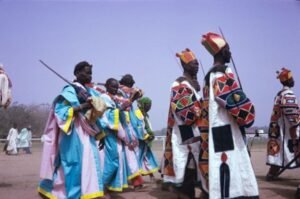
Photo: Helinä Rautavaara, 1977. Helinä Rautavaara Museum, via Wikimedia Commons, CC BY 2.0.
Fashion has always been borrowed from art. A painting becomes a print; a sculpture inspires a shape. What is more interesting is when a designer goes deeper, studying how an artwork was made and what it meant, then interpreting in their own eyes through clothing.
Some of the strongest recent examples come from African and Diaspora designers, in collections shown during 2026 for Fall 2026 and SS27. Their sources include ancient bronzes, a historic festival in Lagos and a Caribbean painter who brought Yoruba spirituality into modern art.
It helps to separate three ideas:
- Collaboration: the designer works with the artist, or the artist’s estate, and credits them.
- Reference: the designer draws on an artwork, a tradition or a piece of history, with no artist involved.
- Influence: the designer borrows a way of thinking or making, not a specific image.
All three can produce beautiful work. The difference matters when we ask who gets credit.
LAGOS / REFERENCE
Weiz Dhurm Franklyn: The Remembering (Ncheta), SS27
Abelia Anaba Franklyn built this collection on the bronzes of Igbo-Ukwu, some of the oldest known bronze works in West Africa, made in what is now Anambra State around the 9th century.
Rather than printing the bronzes onto fabric, she made bronze part of the clothes: hand-sculpted bras, waist pieces and armour-like bodices, with small moulded Igbo-Ukwu forms built in. At Alliance Française in Lagos, the models stood still, like sculptures in a gallery.
This is a cultural reference, not a collaboration with one artist. Its strength is how closely a Nigerian designer studied a Nigerian art tradition and made something new from it.
A bronze ceremonial pot from Igbo-Ukwu, 9th century, Nigerian National Museum, Lagos: the tradition behind Weiz Dhurm Franklyn’s SS27 collection.
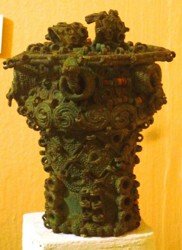
Photo: Ochiwar, via Wikimedia Commons, CC BY-SA 3.0.
LAGOS AND COPENHAGEN / INFLUENCE
IAMISIGO: Sacred Ecologies, SS27
Bubu Ogisi’s Sacred Ecologies looked at how the body relates to land, and at craft knowledge passed down across Africa. One bikini set used crocheted mohair from South Africa and recycled glass beads from Kenya, assembled in Nigeria.
Shown at Copenhagen Fashion Week in August and at Aime Gallery during Lagos Fashion Week, the collection was presented with models standing among the guests. It copies no artwork. Instead, artistic thinking is built into the making itself.
LONDON / REFERENCE
Ahluwalia: Revel, SS27
Priya Ahluwalia, a British designer of Nigerian and Indian heritage, drew partly on FESTAC ’77, the Second World Black and African Festival of Arts and Culture, held in Lagos in 1977. The shapes of the festival fed into her prints, knitwear and embellishment, alongside photographs of Black Panther Party members at demonstrations and at home. “I started thinking about who are these people when they’re off duty?” she said.
It is an archive-based reference: a moment in African cultural history, carried into the present.
The National Theatre in Iganmu, Lagos, built for FESTAC ’77 and still the festival’s best-known landmark.

Photo: Ei’eke, via Wikimedia Commons, CC BY 4.0.
NEW YORK / COLLABORATION
Diotima: Fall 2026, with the Wifredo Lam estate
Rachel Scott, the Jamaican-born designer behind Diotima, worked directly with the estate of Cuban painter Wifredo Lam (1902–1982), whose work blended modern art with Afro-Cuban beliefs rooted in Yoruba tradition.
She chose four paintings, including Omi Obini (1943), whose central figure is believed to be Oshún, the Yoruba goddess of love and fresh water, and works from the Femme-Cheval series. Across eight looks, a 1948 Femme-Cheval was recreated in layered organza and printed onto a silk-wool skirt, while Omi Obini became a jacquard jacket for the finale. Lam’s family flew in from Paris for the show.
Of the examples here, this is the clearest fully credited collaboration. The estate was involved, and the meaning of the paintings, not only their look, shaped the clothes.
THE WIDER CONVERSATION
Art and fashion beyond the main story
The same idea runs well beyond Africa and the Diaspora. For SS27, Burberry worked with British textile artist Celia Birtwell, and MISENITHE brought in painter Nicolò Guarraci and ceramicist Leonardo Pedergnani. For Fall 2026, Akris worked with Colombian textile artist Olga de Amaral, translating her woven works into texture rather than print.
- • •
The relationship between art and fashion is not simply about what a designer sees, but what they choose to carry forward. Sometimes it is an image. Sometimes it is a material, a memory or a way of making. The difference lies in how deeply that reference is understood, how carefully it is translated and whether the artists and histories behind it are properly acknowledged.